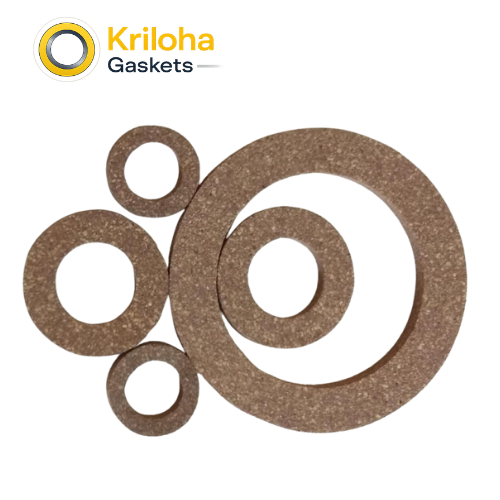
Cork Rubber Gasket

Cork Rubber Gasket

Core Features

  • Composite Material Synergy: Manufactured from a high-density blend of premium Natural Cork granules and high-grade synthetic elastomers (typically Nitrile (NBR) or Neoprene).
  • Controlled Compressibility: The air-filled cellular structure of the cork allows the gasket to compress significantly with very little lateral flow or “side-spread,” ensuring the gasket stays within the flange boundary.
  • Low-Torque Sealing: Specifically designed to create a gas-tight seal at very low bolt loads, making it the ideal choice for lightweight, stamped-metal, or uneven flanges.
  • Excellent Vibration Damping: The natural elasticity of cork combined with rubber provides superior noise and vibration isolation, protecting sensitive mechanical assemblies.
  • Superior Oil & Fuel Resistance: When bonded with Nitrile (NBR), these gaskets offer excellent resistance to petroleum-based fluids, making them a staple in automotive and electrical industries.
  • Conformability: Easily fills microscopic surface irregularities and “bowed” flange conditions common in older equipment and stamped-metal covers.

At Kriloha Ltd., we recognize that not every joint requires the extreme rigidity of metal. In fact, for lightweight covers and stamped flanges, rigidity is often the enemy of a good seal. The Kriloha Cork Rubber Gasket is engineered for “Conformable Containment.” As a premier global supplier of industrial seals, Kriloha Gaskets has mastered the “Micro-Cellular” technology required to turn natural cork into a high-performance industrial barrier.

The science of a Cork Rubber seal is based on Internal Compression. In a standard rubber gasket, when you squeeze it, the material moves outward (side-spread). In a Kriloha cork rubber gasket, the air cells inside the cork granules actually compress. This means the gasket “shrinks” vertically without expanding horizontally. This unique property allows the gasket to maintain its structural integrity even under the uneven pressure of a hand-tightened stamped-metal cover.

Manufacturing these gaskets at Kriloha involves a precision Vulcanization process where the cork granules are molecularly bonded to the rubber matrix. We offer various grades, from Fine-Grain (for high-pressure oil) to Coarse-Grain (for maximum compressibility). Whether you are sealing a massive electrical transformer or a vintage automotive engine, Kriloha Cork Rubber Gaskets provide the vibration-damping and low-torque reliability your equipment demands. By choosing Kriloha Ltd., you are investing in a product that combines the ancient resilience of cork with the modern chemical stamina of synthetic elastomers.
Primary Use Cases

  • Automotive Engines: Providing a reliable seal for oil pans, valve covers, and transmission pans where stamped steel flanges are used.
  • Electrical Transformers: The industry standard for sealing transformer bushings and cooling fins to prevent dielectric oil leaks.
  • General Industrial Machinery: Used in gearboxes, crankcases, and inspection covers where low-pressure oil containment is required.
  • Agricultural Equipment: Reliable sealing for tractor engines and hydraulic reservoirs in high-vibration environments.
  • Small Compressors: Ensuring leak-proof joints in air compressor housings and crankcases.
  •  

FAQs

Why use Cork Rubber instead of plain Rubber?

Plain rubber “squishes” out of the sides of the flange when tightened. Cork rubber compresses internally, meaning it stays in place and requires much less torque to seal, which protects thin or fragile flanges from warping.

Is cork rubber resistant to modern fuels?

Yes, provided it is bonded with Nitrile (NBR). Kriloha’s Nitrile-bonded cork is specifically designed to handle modern oils, diesel, and unleaded gasoline without swelling or breaking down.

What is the maximum temperature for cork rubber gaskets?

Cork rubber is generally suitable for continuous operating temperatures up to +120°C (250°F). Beyond this, the cork granules can become brittle and lose their sealing effectiveness.

Can I reuse these gaskets?

While highly resilient, Kriloha recommends using a new gasket for critical oil-side applications. Because the material conforms so closely to the flange, it takes a “permanent set” that may not realign perfectly if reinstalled.

How do I choose between Fine and Coarse grain?

    • Fine Grain: Best for thin gaskets and higher-pressure oil sealing.
    • Coarse Grain: Best for thicker gaskets where maximum conformability and vibration damping are required on very uneven surfaces.

This is the heading

Lorem ipsum dolor sit amet consectetur adipiscing elit dolor

Request a Quote

Enter your details here

Great! We’ve received your information.

We couldn’t process your submission. Please retry

Scroll to Top

Get a Quote

Great! We’ve received your information.

We couldn’t process your submission. Please retry