Din Pn10 Iso 100 Flange A182 F1 Pipe Flange Plate

Din Pn10 Iso 100 Flange A182 F1 Pipe Flange Plate

Core Features

  • ASTM A182 F1 Low-Alloy Steel Metallurgy: Hot-forged from Carbon-Molybdenum alloy steel, engineered to deliver enhanced creep strength, structural yield stability, and microstructural integrity at elevated temperatures compared to standard carbon steels.
  • ISO DN100 / 4-Inch Nominal Metric Sizing: Precision-machined with an internal clearance bore optimized to slide seamlessly over standard DN100 (4″ Nominal Pipe Size) pipelines or metric industrial tubing conduits.
  • PN10 Low-to-Medium Pressure Rating: Engineered to safely handle continuous system working pressures up to 10 Bar (approximately 145 PSI) under standard reference temperatures, serving as a global utility network benchmark.
  • Dual German & International Framework Alignment: Manufactured in strict accordance with historical DIN templates and modern ISO metric dimensions, ensuring exact drop-in bolt pattern and alignment interchangeability with global valves, pumps, and process equipment.
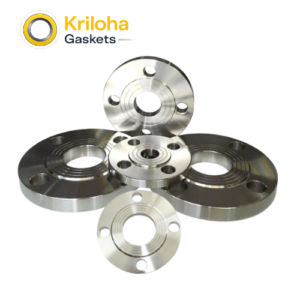
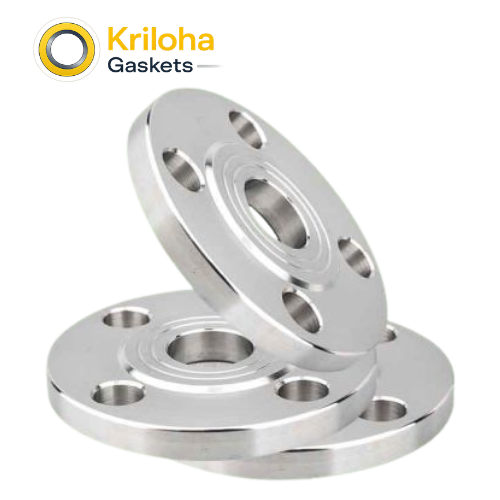
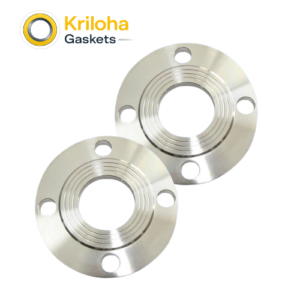
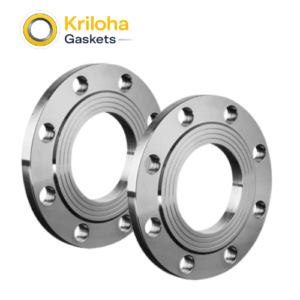
  • Hubless, Structural Plate Geometry: Features a completely flat, collarless circular profile that slides directly over the end of the pipe. This architecture minimizes component weight, reduces raw material volume, and fits easily into tight mechanical footprints.

At Kriloha Gaskets & Hardware, we recognize that modern utility networks require balancing strict metallurgical compliance with structural value. Our ASTM A182 F1 ISO DN100 PN10 Flat Plate Flanges represent our engineered answer for “High-Temperature-Creep-Resistance” and “Flawless-Flat-Alignment.” As a leading premier supplier of integrated flow control elements and pipeline interfaces, Kriloha utilizes automated multi-axis production workflows to ensure that our hubless plate flanges provide superior mechanical longevity.

The engineering of our A182 F1 plate program is founded on Alloy-Traceability and Sharp-Geometric-Precision. Forged from certified low-alloy steel billets rather than lower-grade cast alternatives, our flanges completely eliminate internal voids, gas pockets, and stress concentrations. The presence of Molybdenum in the F1 matrix refines the grain structure, providing the necessary mechanical modulus to withstand high bolt-torque demands across the 8-bolt pattern without bowing, warping, or undergoing structural relaxation over time. At Kriloha, we precision-machine the flat sealing surface on advanced CNC turning centers, finishing them with controlled phonographic serrations that mechanically grip the gasket matrix to resist blowout under sudden system pressure spikes.

Manufacturing and provisioning these critical high-grade components involves strict Dimensional Tolerance Checks, Ultrasonic Flaw Detection, and Surface-Roughness ($R_a$) Calibration. We collaborate directly with your project engineering, procurement, and facility maintenance teams to supply precise internal bores tailored to standard pipe outer diameters and specific wall-thickness schedules (such as matching metric dimensions or standard Sch 40 lines). By choosing Kriloha Gaskets & Hardware, you are investing in a “Future-Proof” industrial partnership that prioritizes your system’s lifetime reliability through superior alloy metallurgy and micro-tolerance engineering.
Primary Industrial Applications

  • Elevated-Temperature Utility Piping: Secondary steam lines, boiler feed networks, and thermal condensate return channels operating under elevated thermal cycles but low-to-medium pressures.
  • Industrial Cooling Tower Headers: Main loop distribution lines for open or closed chilled water circuits inside processing plants, refineries, and power generation facilities.
  • Municipal Water & Sewage Mainlines: Reliable connection joints for large-scale water treatment networks, municipal filtration infrastructure, and wastewater pumping arrays.
  • Low-Pressure Compressed Air & Gas Loops: High-density flat interfaces for factory-wide compressed air networks, ventilation lines, and primary blower intake manifolds.
  • Modular Industrial Skids: Space-saving connection rings used to connect prefabricated utility piping segments directly to flat-faced valves, storage tanks, and strainers.

Frequently Asked Questions (FAQs)

What is the explicit advantage of the ASTM A182 F1 material grade for a plate flange?

While standard plate flanges are often made from carbon steel (like A105 or St37.2), ASTM A182 F1 is a Carbon-Molybdenum low-alloy steel. The addition of molybdenum gives the flange significantly better mechanical properties and resistance to structural weakening (creep) when exposed to elevated temperatures, making it ideal for mild thermal processing loops and steam lines.

Why specify a hubless “Plate Flange” instead of a traditional hubbed Slip-On flange for a DN100 line?

Because a plate flange completely lacks a raised collar or hub, it uses significantly less raw material during manufacturing. This makes it a highly compact, lightweight, and cost-effective alternative for standard process networks and utility lines where the extra structural reinforcement of a heavy hub is not functionally required.

What specific welding configuration is required to install this type of plate flange?

An ISO plate welding flange requires a standard double fillet weld setup for proper installation: one robust fillet weld around the rear side where the plate meets the outer diameter of the pipe wall, and a secondary fillet weld along the inside bore face where the pipe end sits flush with the flange face.

How does the metric sizing scale for an “ISO 100 / DIN PN10” bolt pattern translate?

“ISO 100” (or DN100) translates to a 100mm Nominal Diameter, which corresponds directly to a 4-inch Nominal Pipe Size (NPS 4). For a PN10 pressure rating, the flange standard dictates an outer diameter of 220mm and an 180mm bolt circle diameter utilizing an 8-bolt configuration with M16 bolts.

Are Material Test Reports (MTRs) provided with these alloy steel plate flanges?

At Kriloha Ltd., quality assurance is completely non-negotiable. Every shipment from our facility can be accompanied by comprehensive Material Test Reports (MTRs) confirming exact chemical compositions (including precise Carbon and Molybdenum percentages), hardness values, yield/tensile strength data, and explicit compliance with international dimensional standards to guarantee complete industrial traceability.

This is the heading

Lorem ipsum dolor sit amet consectetur adipiscing elit dolor

Request a Quote

Enter your details here

Great! We’ve received your information.

We couldn’t process your submission. Please retry

Scroll to Top

Get a Quote

Great! We’ve received your information.

We couldn’t process your submission. Please retry