
CHECK VALVES
In the high-pressure environment of industrial fluid systems, maintaining unidirectional flow is not just a requirement—it is a critical safety mandate. Kriloha Gaskets, a premier authority in industrial sealing and fluid control hardware, offers a sophisticated range of Check Valves within our Valve and Fitting Accessories main category.
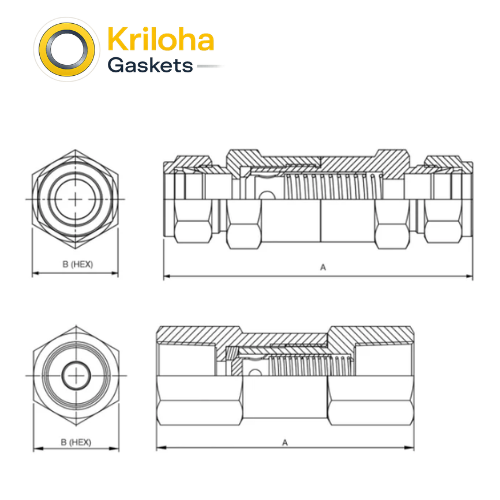
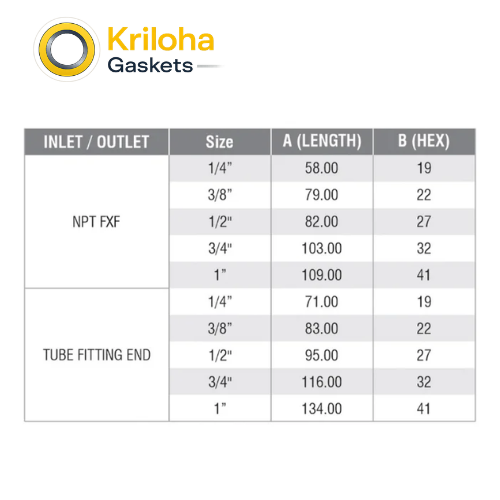
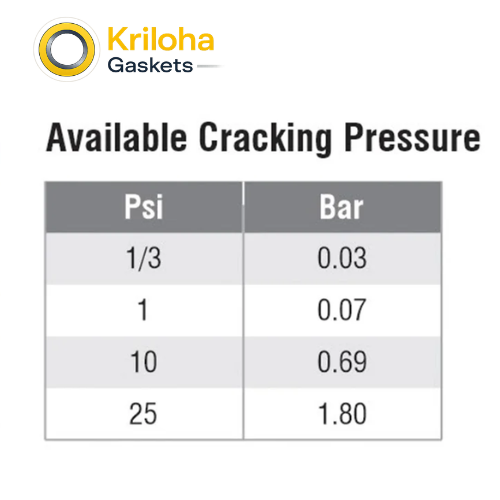
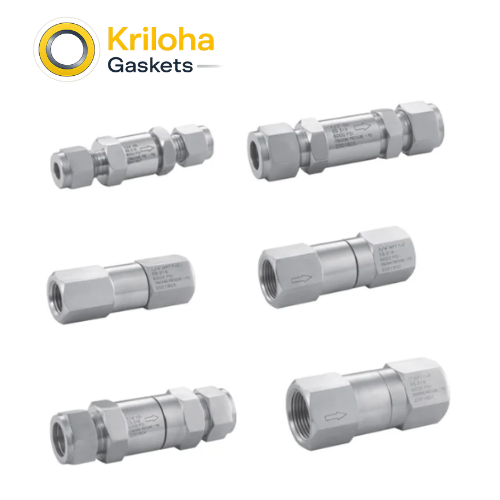
Catagories
What is a Check Valve?
A check valve is a mechanical device that permits fluid (liquid or gas) to flow through it in only one direction. Unlike ball or needle valves, check valves are self-actuated; they do not require an operator or an external power source to function. Instead, they rely on a pressure differential.
When the upstream pressure exceeds the “cracking pressure” (the force required to overcome the internal spring or gravity), the valve opens. As soon as the flow stops or reverses, the valve closes automatically, creating a bubble-tight seal that prevents reverse contamination or mechanical damage.
Technical Specifications and Material Science
At Kriloha Gaskets, we treat every valve as an extension of our commitment to excellence. Our check valves are manufactured from premium-grade forgings and bar stock to ensure structural integrity and a long service life under high-cycle conditions.
Premium Material Options:
Stainless Steel (316/316L/304): The industry standard for corrosion resistance, ideal for chemical, pharmaceutical, and offshore applications.
Carbon Steel (ASTM A105): A high-strength solution for oil and gas pipelines where corrosion is managed and mechanical durability is paramount.
Brass & Bronze: Excellent for water systems, marine applications, and pneumatic lines due to their spark-resistant properties.
Exotic Alloys: For aggressive media, we offer valves in Monel, Inconel, and Hastelloy to resist pitting and stress-corrosion cracking.
Engineering Standards:
Pressure Ratings: Standard stock ranges from 3,000 PSI to 6,000 PSI, with custom-forged units available up to 10,000 PSI.
Temperature Ranges: Capable of operating from cryogenic temperatures to 538°C (1,000°F) when equipped with specialized metal seats.
Sealing Surface: We provide both metal-to-metal seats for high-temperature durability and soft seats (Viton, PTFE, EPDM) for bubble-tight gas service.
Why Choose Kriloha Gaskets for Your Valve Accessories?
While many vendors sell valves, Kriloha Gaskets provides an integrated approach to fluid handling.
1. Superior Sealing Expertise
As experts in gasket manufacturing, we understand the molecular level of sealing. We apply this knowledge to our valve seats, ensuring that our “metal-to-metal” seals provide industry-leading performance even at low back-pressures.
2. Adjustable Cracking Pressures
We provide valves with adjustable springs, allowing engineers to set the exact “opening” pressure required for their specific system requirements, ensuring maximum control over fluid dynamics.
3. Rigorous Quality Control
Every valve undergoes hydrostatic and pneumatic testing at 1.5 times its rated working pressure. We provide full Material Test Certificates (MTC) and ensure compliance with international standards like ASME B16.34.
Available Profile Configurations
Installation and Maintenance Best Practices
To ensure the longevity of your check valves, follow these professional guidelines:
Check the Arrow: Every Kriloha valve is laser-etched with a flow arrow. Installing the valve in the wrong direction will lead to immediate system blockage.
Upstream Filtration: Check valves are sensitive to grit and debris. We recommend installing an upstream strainer to prevent particulates from damaging the valve seat.
Orientation: While spring-loaded valves can often be installed in any orientation, certain swing and ball check valves require horizontal or vertical-up installation for gravity to assist the seal.
Frequently Asked Questions (FAQ's)
Q: What is "Cracking Pressure," and how do I choose the right one?
A: Cracking pressure is the minimum upstream pressure required to open the valve. For most instrumentation, a low cracking pressure (e.g., 0.3 to 1 PSI) is preferred to minimize pressure drop. However, higher cracking pressures (10–25 PSI) are used to prevent siphoning or unintended mixing.
Q: Can I use a check valve for pressure relief?
A: No. While they look similar, check valves are not safety relief devices. A dedicated relief valve is designed to open at a specific set point to protect the system from over-pressurization.
Q: Are Kriloha check valves suitable for "Sour Gas" (H2S) environments?
A: Yes. We offer specific models that comply with NACE MR0175/ISO 15156, utilizing specially heat-treated materials to resist sulfide stress cracking.
Q:How do I stop my check valve from "Chattering"?
A: Valve chatter usually occurs when the valve is oversized for the flow rate. Selecting a valve with a cracking pressure closer to your operating pressure, or choosing a spring-loaded poppet design, can resolve this.
Q: What end connections are available for the Kriloha range?
A: We stock a wide variety of ends, including NPT (Male/Female), BSPT, and compression tube fittings (double ferrule) to ensure a seamless fit into your existing tubing or piping system.
Contact Kriloha Ltd. Today
for your valve and fitting parts accessories requirements. Invincible Seals. Agile Solutions.