
THERMOWELLS
In the complex ecosystem of industrial processing, temperature is a critical variable that dictates product quality, system safety, and energy efficiency. However, the sensors used to measure this heat—thermocouples, RTDs, and bimetal thermometers—are often delicate. Kriloha Gaskets, a premier authority in industrial hardware and sealing solutions, provides a specialized range of Thermowells within our Valve and Fitting Accessories category.
Catagories
What is a Thermowell?
A thermowell is a cylindrical, pressure-tight fitting designed to hold and protect a temperature sensor. It is permanently installed into piping or vessels, acting as a closed-end tube that protrudes into the flow stream.
The Core Functionality:
Protection: It shields the sensor from high pressure, high velocity, and corrosive chemicals.
Maintenance Efficiency: It allows for the removal and replacement of a sensor without “breaking” the process line. This means you can calibrate or replace a thermometer without shutting down the plant or draining the pipes.
Safety: It acts as a primary pressure boundary, ensuring that if a sensor fails, the process media remains contained.
Technical Specifications and Material Selection
At Kriloha Gaskets, we treat thermowell manufacturing as a precision science. Because the thermowell is a “wetted” part, its metallurgy must be perfectly matched to the process fluid.
Premium Material Options:
Stainless Steel (316/316L): The industry standard, offering excellent resistance to corrosion and oxidation.
Carbon Steel (A105): Used in non-corrosive, high-pressure hydraulic or oil-based systems.
Exotic Alloys (Monel, Inconel, Hastelloy): For aggressive chemical environments, including sour gas and concentrated acids.
Duplex & Super Duplex: Ideal for seawater or high-chloride environments where stress corrosion cracking is a risk.
Design Standards:
Our thermowells are designed and tested in accordance with ASME PTC 19.3 TW. This standard involves rigorous “Wake Frequency Calculations” to ensure the thermowell can withstand the stresses of fluid flow without snapping or vibrating to the point of failure.
Types of Thermowells in the Kriloha Range
To suit varied installation requirements, we offer three primary stem designs:
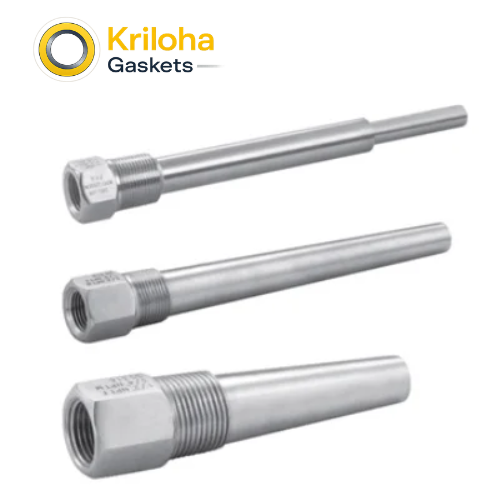
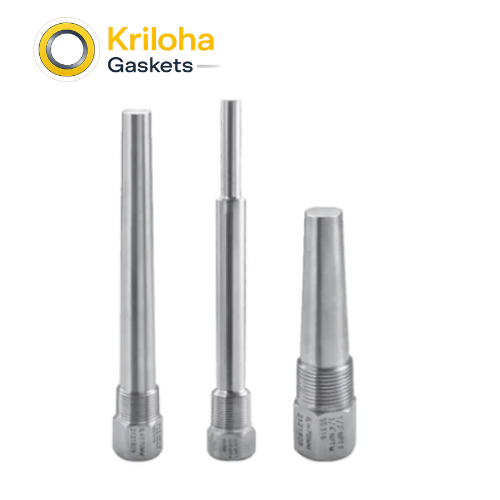
Straight Thermowells: The diameter is consistent along the entire insertion length. These provide good protection but have a slower response time due to the mass of the metal.
Stepped Thermowells: The tip has a smaller diameter than the base. This design offers a faster response time while maintaining a robust mounting base.
Tapered Thermowells: The diameter gradually decreases from the base to the tip. These provide the best balance between a fast response time and high mechanical strength against high-velocity flows.
Connection Types:
Threaded: Screws directly into a pipe tee or welded “olet.” (NPT or BSPT).
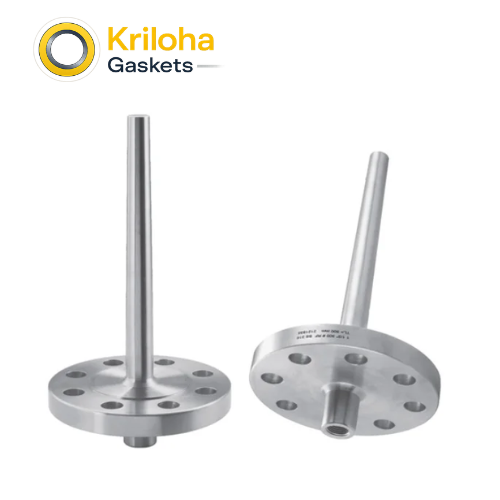
Flanged: Bolted to a mating flange on the process vessel—ideal for high-pressure or corrosive systems where frequent inspection is required.
Socket Weld: Welded permanently into the system for a leak-proof, high-pressure connection.
The Kriloha Advantage: Engineering for Accuracy
Why source your thermowells from Kriloha Gaskets? Because we understand the intersection of Sealing and Sensing.
1. Superior Thermal Response
Our thermowells are machined with precision internal tolerances to ensure the “bore” fits the sensor snugly. This minimizes the air gap, ensuring heat is transferred rapidly from the process to the sensor.
2. Wake Frequency Verification
For high-velocity steam or liquid lines, we provide a Wake Frequency Calculation Report. This engineering service ensures the thermowell won’t fail due to flow-induced resonance, a common cause of catastrophic failure in industrial piping.
3. Integrated Sealing Kits
As experts in gaskets, we provide the complete installation package. When you order a flanged thermowell, we provide the matching Spiral Wound Gasket and high-tensile bolting to ensure a perfect, leak-free seal from day one.
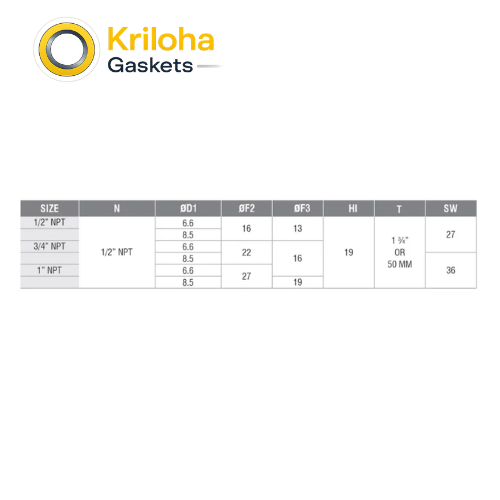
Available Profile Configurations
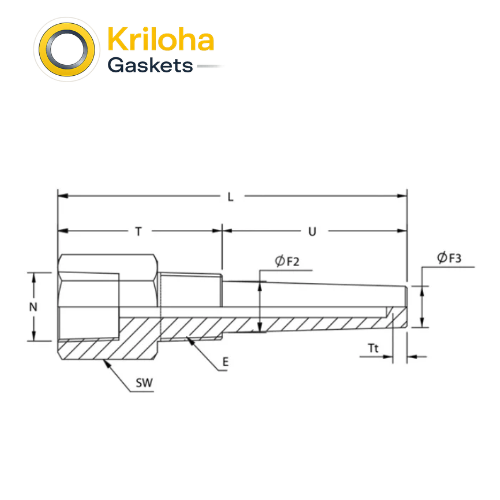
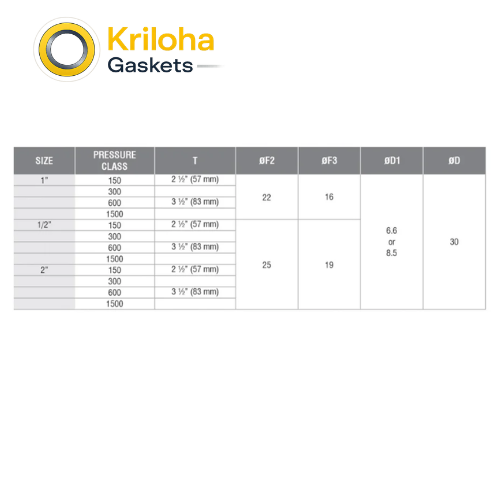
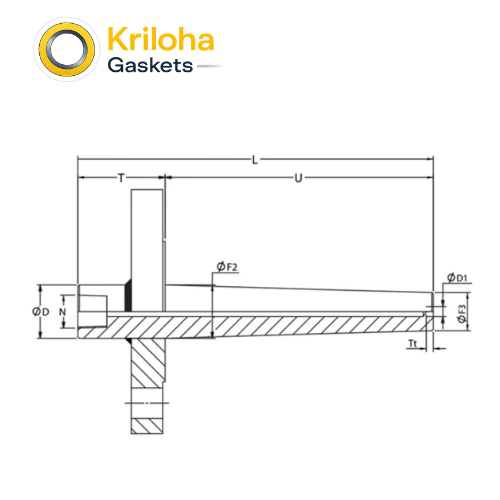
Maintenance and Installation Best Practices
Immersion Length: For accurate readings, the thermowell should be immersed to a depth of at least 10 times its diameter in liquids and 15 times its diameter in gases.
The Use of Heat Transfer Paste: To improve response time, a thermal conductive paste can be used inside the thermowell, provided the temperature remains within the paste’s operating range.
Regular Inspection: In corrosive media, periodically check the thermowell for thinning (erosion) or pitting. A compromised thermowell is a safety hazard.
Frequently Asked Questions (FAQ's)
Q: What is the "U-Length" of a thermowell?
A:The U-length is the “Insertion Length”—the distance from the bottom of the connection to the tip of the thermowell. This is the portion that actually sits inside the process stream.
Q: How do I choose between a Threaded and a Flanged thermowell?
A: Threaded thermowells are cost-effective and easier to install in small pipes. Flanged thermowells are preferred for high-pressure, high-temperature, or highly corrosive applications because they are easier to replace and provide a more robust seal.
Q: Does a thermowell slow down the temperature reading?
A: Yes, adding a layer of metal between the process and the sensor adds “thermal lag.” However, by choosing a Tapered or Stepped design, you can significantly minimize this delay while maintaining safety.
Q: Can Kriloha provide NACE-compliant thermowells?
A: Absolutely. For sour gas service where H2S is present, we provide thermowells that meet NACE MR0175/ISO 15156 standards, utilizing hardness-controlled materials.
Q: What is a "Lagg" or "Extension" on a thermowell?
A:A “Lagging Extension” is an extra length between the process connection and the sensor head.This is used when the pipe is insulated, allowing the sensor head to sit outside the insulation layer.
Contact Kriloha Ltd. Today
for your valve and fitting parts accessories requirements. Invincible Seals. Agile Solutions.