
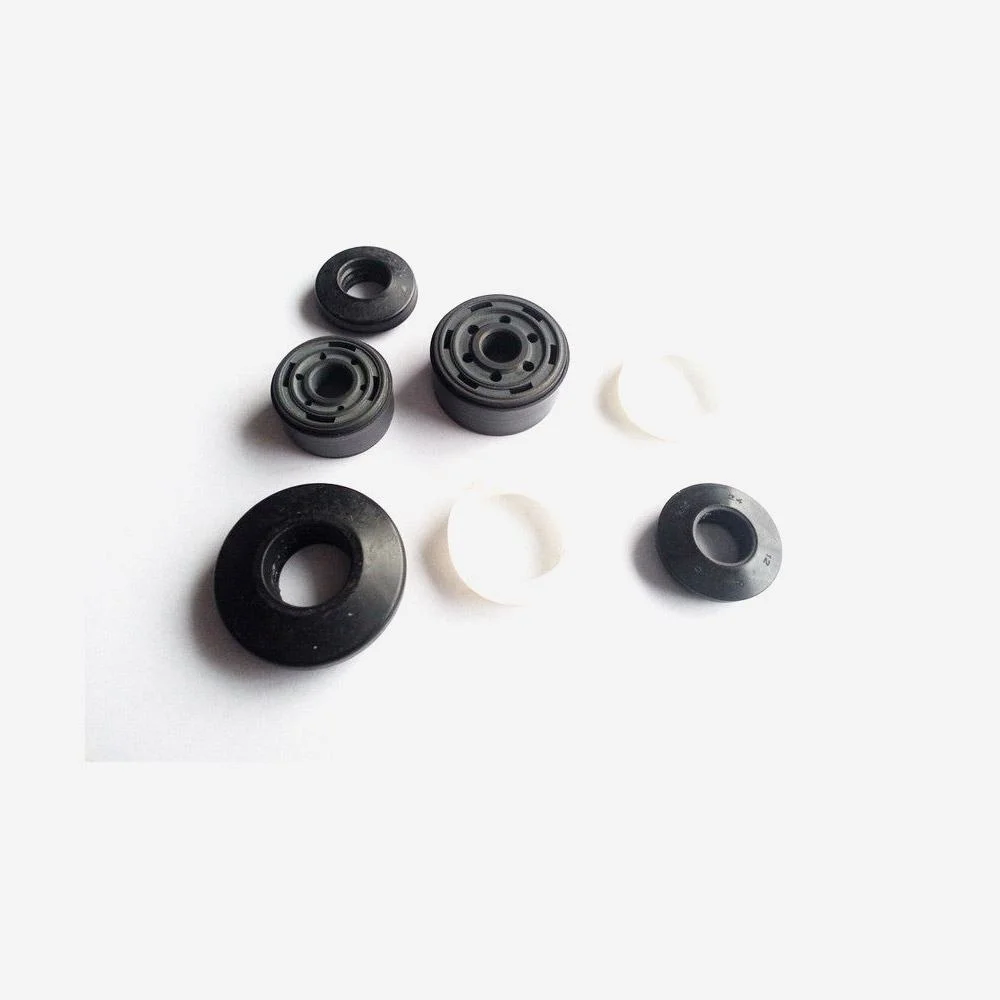
PTFE Bonded Rubber Parts

PTFE Bonded Rubber Parts

Core Features

  • Dual-Material Synergy: Combines the extreme chemical inertness and low friction of a PTFE (Teflon™) face with the elastic memory and compressibility of a premium rubber core.

  • Ultimate Chemical Resistance: The PTFE layer acts as an impenetrable shield, protecting the underlying elastomer from aggressive acids, harsh alkalis, reactive solvents, and corrosive petrochemicals.

  • Eliminates “Cold Flow” (Creep): Unlike solid PTFE gaskets that deform and thin out under continuous pressure, the bonded rubber core provides a resilient “spring-back” action to maintain a tight seal over time.

  • Ultra-Low Friction Surface: The non-stick PTFE face significantly reduces mechanical wear, lowers the operating torque required for valves, and prevents the gasket from sticking to metal flanges during maintenance.

  • Permanent Vulcanized Bond: Employs advanced surface-etching technology and proprietary bonding agents to chemically fuse the PTFE film directly to the elastomer, preventing delamination.

  • High-Purity & Sanitary Compliance: The non-porous, non-reactive PTFE surface is naturally anti-microbial and easily cleanable, making it ideal for FDA-compliant food, beverage, and pharmaceutical applications.

Advanced PTFE Bonded Rubber Parts by Kriloha Gaskets

In the complex world of industrial fluid control, engineers frequently face a difficult compromise: choose a standard rubber gasket that offers excellent sealing flexibility but degrades rapidly upon exposure to harsh chemicals, or choose a solid PTFE (Teflon™) gasket that offers universal chemical resistance but is excessively rigid and prone to “cold flow” (creep) under continuous compression. To completely eliminate this compromise, Kriloha Gaskets manufactures premium PTFE Bonded Rubber Parts. By permanently fusing a protective layer of pure PTFE directly to a resilient elastomeric core, we deliver a hybrid sealing solution that provides the absolute best of both materials—flawless chemical resistance combined with unyielding elastic memory.

The Science of Inseparable PTFE Bonding Bonding anything to PTFE is notoriously difficult due to its inherently non-stick, low-surface-energy properties. Standard adhesives simply wipe off. At Kriloha Gaskets, we utilize a highly advanced chemical etching and vulcanization process to achieve a permanent bond. First, one side of the thin PTFE film or sheet is chemically etched to microscopically alter its surface structure, creating a texture that allows for adhesion. During the molding phase, this etched PTFE is placed into the tool along with the raw, uncured elastomer compound. Under intense heat and immense pressure, the rubber cross-links directly with the etched PTFE surface, creating a permanent molecular bond. This ensures the protective face will never peel, blister, or delaminate, even under severe dynamic flexing or vacuum conditions.

Solving the “Cold Flow” Problem The most significant engineering flaw of solid virgin PTFE gaskets is their tendency to undergo “cold flow”—a phenomenon where the plastic slowly deforms, flattens, and extrudes out of the flange joint under continuous clamping pressure, eventually leading to a leak. Kriloha’s PTFE Bonded Parts completely solve this issue. The resilient rubber core absorbs the compressive load and acts as an internal spring. As the flange shifts or expands due to thermal cycling, the rubber expands with it, continuously pressing the impermeable PTFE face firmly against the mating surface to maintain a bubble-tight seal over an extended operational lifespan.

Low-Friction Performance for Dynamic Systems Beyond static flange sealing, PTFE bonded rubber is highly sought after for dynamic applications. The ultra-low coefficient of friction provided by the PTFE face drastically reduces mechanical drag. When used as valve seats or pump diaphragms, this translates to less operational torque required to actuate the valve, reduced wear and tear on the machinery, and a significantly extended component life. Furthermore, the non-stick surface ensures that the gasket will not adhere to metal flanges over time, preventing costly flange damage and scraping during routine maintenance and replacement.

Custom Engineered for Exacting Specifications Kriloha Gaskets partners with your engineering team to design custom PTFE bonded solutions tailored to your exact operational parameters. We expertly match the required thickness of the PTFE shield with the optimal elastomer backing—such as EPDM for standard chemical processing, FKM (Viton) for severe high-temperature environments, or Nitrile for petrochemical applications. Whether you require standard PTFE-faced flange gaskets, complex molded pump diaphragms, or custom low-friction seals, we deliver precision components that guarantee uncompromising safety and performance in the world’s most aggressive industrial environments.
Primary Use Cases

  • Chemical and Petrochemical Processing: Used as flange gaskets, pipe seals, and tank linings in systems handling highly aggressive acids, caustic alkalis, and reactive solvents that would destroy unprotected rubber.

  • Air-Operated Double Diaphragm (AODD) Pumps: Utilized as heavy-duty pump diaphragms where the part must withstand millions of dynamic flexing cycles while simultaneously resisting corrosive chemical transfer.

  • Pharmaceutical and Food Production: Ideal for sanitary seals, tri-clamp gaskets, and fluid transfer lines requiring a non-porous, FDA-compliant surface that imparts no taste or odor and withstands rigorous CIP/SIP cleaning cycles.

  • Industrial Butterfly and Ball Valves: Deployed as low-friction valve seats and liners, allowing for smooth, low-torque actuation while maintaining an impermeable barrier against aggressive media.

  • Semiconductor Manufacturing: Integrated into high-purity fluid handling systems where ultra-clean, non-contaminating, and chemically inert seals are strictly required.

FAQ

1. Why shouldn’t I just use a solid, 100% PTFE gasket?

Solid PTFE is a hard plastic that lacks elasticity. Under continuous clamping pressure, it suffers from “cold flow” or creep, meaning it slowly flattens out and loses its seal, requiring constant retorquing of the bolts. A Kriloha PTFE bonded rubber part uses the rubber core to provide continuous “push-back” (elastic memory), ensuring a tight seal without the cold flow issues, while the PTFE face provides the necessary chemical resistance.

2. Will the PTFE layer peel or delaminate from the rubber core over time?

No. We do not use standard glues to attach the PTFE to the rubber. We utilize a specialized process where the PTFE is chemically etched and then vulcanized directly to the elastomer under extreme heat and pressure. This creates a permanent molecular bond that is designed to withstand severe dynamic flexing, temperature swings, and chemical exposure without delaminating.

3. What types of rubber can be bonded to the PTFE face?

We can bond PTFE to a variety of high-performance elastomers based on your application’s temperature and physical requirements. The most common pairings are PTFE bonded to EPDM (excellent for general chemical and sanitary use), PTFE bonded to FKM/Viton (for high heat), and PTFE bonded to Nitrile (Buna-N).

4. Are these gaskets suitable for high-purity food and medical applications?

Yes. PTFE is inherently inert, non-toxic, and naturally resists microbial growth. When bonded to an FDA-compliant or medical-grade silicone or EPDM core, these composite parts are ideal for food and beverage processing, pharmaceutical manufacturing, and sanitary tri-clamp fittings.

5. Can PTFE bonded parts be used in dynamic (moving) applications?

Absolutely. In fact, dynamic applications are one of their primary uses. Because PTFE has an extremely low coefficient of friction (it is naturally non-stick), these parts are frequently used as diaphragms in industrial pumps and as seats in rotary valves, where they significantly reduce mechanical wear and operating torque.

This is the heading

Lorem ipsum dolor sit amet consectetur adipiscing elit dolor

Request a Quote

Enter your details here

Great! We’ve received your information.

Scroll to Top

Get a Quote

Great! We’ve received your information.