Metal C-Rings

Metal C-Rings

Core Features

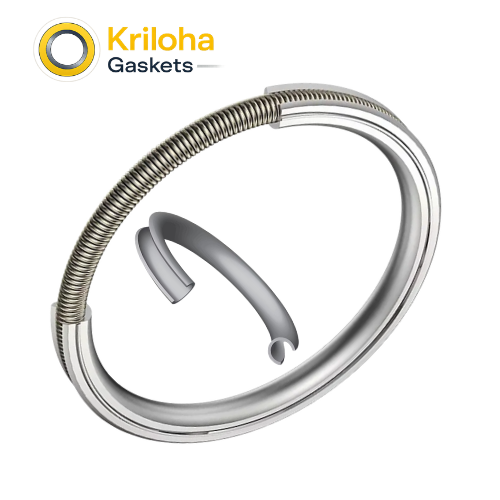
  • High-Resiliency “C” Profile: Features an open-sided circular cross-section that acts as a high-tension spring, providing superior elastic recovery compared to hollow metal O-rings.
  • Internal Pressure-Actuated Design: The open side of the “C” is always positioned toward the system pressure. As pressure increases, it flows into the ring, forcing the sealing lips outward and naturally increasing the sealing force.
  • Low Bolt-Load Sealing: Due to its flexible geometry, a C-ring requires significantly less clamping force to achieve a seal than a solid or hollow metal O-ring, making it ideal for lightweight or temperature-sensitive flanges.
  • Extreme Temperature & Vacuum Integrity: Capable of maintaining a hermetic seal from cryogenic levels (-250°C) up to intense heat (+800°C) using high-nickel alloys like Inconel 718.
  • Specialized Plating & Ductile Coatings: Available with Silver, Gold, PTFE, or Nickel plating. These soft outer layers flow into flange imperfections under load to ensure a gas-tight, bubble-free seal.
  • Excellent Spring-Back: Designed to compensate for “flange separation” caused by thermal cycling or extreme pressure surges, ensuring the seal remains energized even as the hardware moves.

At Kriloha Ltd., we recognize that in the most demanding aerospace and scientific applications, a seal must be more than just a barrier—it must be “Dynamic.” If a flange expands due to heat, a standard seal can lose contact. The Kriloha Metal C-Ring is our engineered answer for high-recovery sealing. As a premier global provider of advanced seals, Kriloha Gaskets has mastered the Precision Cold-Forming and heat-treating processes required to give these rings their “spring-like” memory.

The physics of a Kriloha Metal C-Ring is based on Pressure-Assisted Energization. Unlike an O-ring, which is a closed loop, the “C” profile allows the internal system pressure to do the work for you. At Kriloha, we utilize Inconel 718 or 17-4 PH Stainless Steel for the base metal. These materials are precipitation-hardened to ensure they don’t lose their “spring” at high temperatures. We then apply a Soft Silver Plating (typically 30–50 microns thick) which acts as a microscopic gasket, “smearing” into the flange machine marks to eliminate any potential leak path.

Manufacturing these seals at Kriloha involves strict Spring-Constant Calibration. We ensure that the “Face-Load” (the force required to compress the ring) is perfectly matched to your flange’s bolting capacity. We offer these in three primary orientations: Internal Pressure (Open OD), External Pressure (Open ID), and Axial Pressure. Whether you are sealing a high-altitude sensor or a high-pressure chemical reactor, Kriloha Metal C-Rings provide the mechanical agility and chemical permanence your most ambitious projects demand. By choosing Kriloha Ltd., you are investing in a “Smart Seal” technology that adapts to its environment.
Primary Use Cases

  • Gas Turbine Engines: Sealing combustion chambers and fuel nozzles where high vibration and thermal expansion occur simultaneously.
  • Vacuum Deposition Equipment: Providing ultra-high vacuum (UHV) seals for semiconductor and thin-film coating chambers with zero outgassing.
  • Plastic & Fiber Extrusion: Ideal for sealing die heads and polymer melt filters where high heat and frequent cleaning are required.
  • Nuclear Research & Fusion: Critical sealing for experimental reactors and particle accelerators where radiation resistance is mandatory.
  • Cryogenic Valves & Pumps: Maintaining seal integrity in liquid nitrogen, oxygen, and hydrogen transport systems.
  •  

FAQs

What is the main advantage of a C-Ring over a Metal O-Ring?

A C-ring has much higher “Spring-Back” (recovery). If your flanges move slightly due to heat or pressure, a C-ring can expand to follow that movement, whereas a hollow O-ring has very limited recovery.

Which way should the “Open Side” of the C-ring face?

The open side must always face the higher pressure. This allows the fluid pressure to enter the “C” and push the sealing lips harder against the flange faces.

Can I use a C-Ring on a standard flat flange?

C-rings are almost always installed in a machined groove (gland). The groove depth is critical because it acts as a “compression stop” to prevent the ring from being over-crushed and losing its spring properties.

What surface finish do I need on my flanges?

Because metal seals are less “forgiving” than rubber, Kriloha recommends a surface finish of 32 RMS (0.8 µm Ra) or better. The smoother the surface, the easier it is for the silver or gold plating to create a hermetic seal.

Is this seal “Fire-Safe”?

Absolutely. Since it is constructed entirely of high-performance alloys and metallic platings, the C-ring is inherently non-combustible and will maintain its sealing integrity during and after a fire event.


This is the heading

Lorem ipsum dolor sit amet consectetur adipiscing elit dolor

Request a Quote

Enter your details here

Great! We’ve received your information.

We couldn’t process your submission. Please retry

Scroll to Top

Get a Quote

Great! We’ve received your information.

We couldn’t process your submission. Please retry