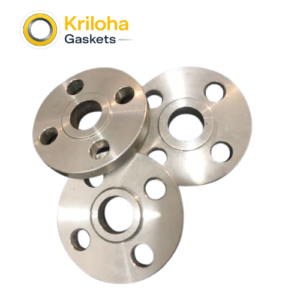

Pn16 Flange Ss Flange Slip On Flange Slip On Flat Face Flange

Pn16 Flange Ss Flange Slip On Flange Slip On Flat Face Flange

Stainless Steel Forged Slip-On Flat Face (FF) Flange (PN16 Rating)

Category: Flanges | Sub-Category: Slip-On Flange / Flat Face Plate Family

Core Features

  • Flat Face (FF) Sealing Configuration: Engineered with a completely flat mating surface across the entire face, extending out to the outer diameter of the flange ring. It lacks the elevated step found on Raised Face (RF) flanges. This layout is specifically designed to maximize contact area, distributing bolt-clamping forces evenly to prevent damage when connecting to brittle cast-iron components.
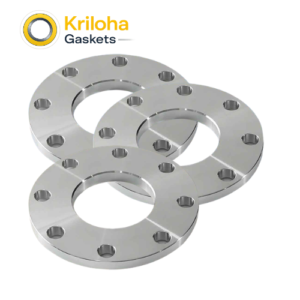
  • Metric Pressure Rating Compliance (PN16): Precision-machined to conform strictly to European DIN / EN 1092-1 (Type 01 or Type 12) dimensional parameters for 16-bar pressure execution. This guarantees perfect alignment, bolt-hole spacing, and pitch circle diameter (PCD) interchangeability across international process arrays.
  • Premium Austenitic Stainless Steel Core: Forged from high-grade stainless steel (typically Grade 304L or 316L), providing superior resistance against localized atmospheric rust, chemical oxidation, pitting, and stress-corrosion cracking.
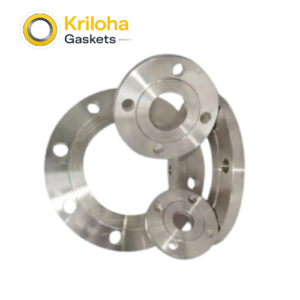
  • Low-Profile Slip-On (SO) Architecture: Precision-machined with a center clearance internal bore that slides smoothly over the outside diameter of standard process piping. This design allows for quick manual rotation, making alignment and bolt-hole positioning simple during field installation.
  • Double Fillet Weld Joint Security: Permanently attached to the pipeline using a standard double fillet weld matrix: one robust weld tracking the exterior rear perimeter where the pipe wall meets the flange collar, and a secondary fillet weld inside the bore to create a leak-proof structural connection.

At Kriloha Gaskets & Hardware, we recognize that modern process networks require a careful balance of physical component compatibility with specialized material performance. Our PN16 Forged Stainless Steel Slip-On Flat Face (FF) Flanges represent our engineered answer for “Stress-Free-Equipment-Interfacing” and “Deflection-Resistant-Flatness” across diverse process setups. Operating from our advanced automated fabrication facilities, Kriloha utilizes multi-axis CNC tooling to machine exact inner diameter tolerances, ensuring a seamless interface with your pipeline configurations.

The engineering of our flat face slip-on program is founded on Microstructural Uniformity and Strict Geometrical Precision. By forcing certified Grade 304L or 316L stainless steel stock through controlled forging paths rather than relying on lower-cost casting alternatives, we completely eliminate internal gas pockets, casting porosities, and structural micro-cracks. The refined metal grain structure smoothly traces the flat geometry of the ring, providing the high structural modulus required to withstand intense bolt-torque demands across the metric bolt circle without warping or undergoing structural relaxation over time. To ensure a tight, leak-proof joint alongside your soft gaskets, our automated turning stations finish the specified mating surface with smooth, parallel concentric face lines ( finish) that maximize seal contact without tearing soft elastomer or full-face rubber matrices.

Manufacturing and provisioning these critical high-grade components involves strict Dimensional Tolerance Checks, Volumetric Material Inspections, and Surface Roughness Calibration. We collaborate directly with your project engineering, procurement, and facility maintenance teams to supply precise internal bores tailored to standard pipe outer diameters and unique wall-thickness schedules (such as Schedule 10S or Schedule 40S matching). By choosing Kriloha Gaskets & Hardware, you are investing in a “Future-Proof” industrial partnership that prioritizes your system’s lifetime reliability through superior stainless metallurgy and micro-tolerance engineering.
Primary Industrial Applications

  • Cast Iron Valve & Pump Interfacing: The standard choice for connecting stainless steel pipelines directly to brittle cast-iron or bronze valves, pumps, strainers, and suction headers without risk of fracturing the cast components.
  • Low-to-Medium Pressure Plant Utilities: Ideal for main factory utility lines distributing industrial water, low-pressure compressed air loop arrays, cooling tower circuits, and non-corrosive gas piping.
  • Hygienic Process Pipelines: Clean-utility networks in pharmaceutical manufacturing, cosmetics packaging, dairy bottling plants, and food/beverage processing where non-porous stainless steel prevents fluid contamination and survives clean-in-place (CIP) steam washdowns.
  • Water Treatment & Environmental Utilities: High-density flat interfaces for chemical dosing skids, municipal wastewater filtration networks, and corrosive fluid drainage manifolds.
  • Modular Compact Process Skids: Low-profile connection interfaces preferred by prefabricated equipment manufacturers for routing fluid lines within compact, space-restricted structural frames.

Frequently Asked Questions (FAQs)

What is the fundamental purpose of choosing a Flat Face (FF) flange over a Raised Face (RF) flange?

A Flat Face (FF) flange features a completely flat surface across its entire face, from the inner bore to the outer edge. It is primarily specified when connecting steel or stainless steel pipelines directly to brittle materials like cast iron, bronze, or plastic components. Because the face is flat, the bolt torque forces are distributed evenly over the entire surface, preventing a bending moment that could crack or fracture the fragile mating flange.

Can a Flat Face (FF) stainless steel flange be safely bolted directly to a Raised Face (RF) flange?

It is highly recommended not to mate a Flat Face flange directly to a Raised Face flange. When bolted together, the raised face concentrates all the bolt-clamping force inside the bolt circle, creating an uneven bending stress on the flat face flange that can cause warping or joint leakage. Best engineering practice dictates matching face styles like-to-like (Flat Face to Flat Face).

What specific welding configuration is required to install a PN16 Slip-On flange?

A slip-on flange requires a standard double fillet weld setup for proper code-compliant installation:

One robust fillet weld around the exterior rear side where the flange collar meets the outer diameter of the pipe wall.

A secondary fillet weld inside the bore, where the pipe end is slid back slightly (typically equal to the pipe wall thickness plus 3mm) from the flange face to prevent heat or weld spatter from damaging the machined sealing surface.

When should I select Grade 316L stainless steel over Grade 304L for this product?

Grade 304L is highly economical and excellent for freshwater processing, commercial HVAC loops, standard food-grade utilities, and clean factory environments. If your pipeline is handling aggressive chemical acids, highly concentrated salt brines, or is installed in an offshore marine environment exposed to heavy salt spray, upgrading to Grade 316L (which contains molybdenum) is mandatory to prevent localized pinhole pitting.

Are Material Test Reports (MTRs) provided with these dual-standard flanges from Kriloha?

At Kriloha Ltd., quality assurance is completely non-negotiable. Every shipment from our facility can be accompanied by comprehensive Material Test Reports (MTRs) confirming exact chemical compositions (including precise Carbon, Chromium, Nickel, and Molybdenum content), hardness values, yield/tensile strength data, and explicit compliance with international industrial standards to guarantee complete industrial traceability.

This is the heading

Lorem ipsum dolor sit amet consectetur adipiscing elit dolor

Request a Quote

Enter your details here

Great! We’ve received your information.

We couldn’t process your submission. Please retry

Scroll to Top

Get a Quote

Great! We’ve received your information.

We couldn’t process your submission. Please retry