Premium Double Jacket Gasket

Premium Double Jacket Gasket

Core Features

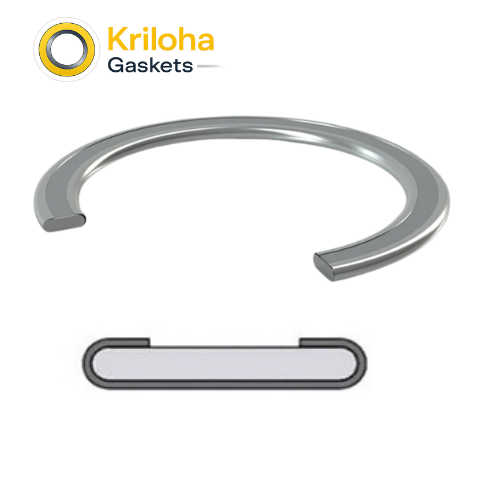
  • Composite Armor Construction: Features a soft, compressible filler material (typically Graphite, Ceramic, or PTFE) completely encapsulated within a metallic shell or “jacket.”
  • Enhanced Blow-out Resistance: The metallic jacket provides a rigid physical boundary that prevents the internal filler from extruding or blowing out under high-pressure conditions.
  • High-Temperature Stability: By using a metal shell (Stainless Steel, Soft Iron, or Monel), the gasket can operate in extreme thermal environments up to 1000°C (depending on the metal and filler combination).
  • High Seating Stress Capability: Engineered to withstand the massive bolt loads required for large-diameter heat exchanger flanges without structural collapse.
  • Chemical Protection: The metallic jacket acts as a primary barrier, protecting the internal filler from direct contact with aggressive or corrosive process media.
  • Versatile Geometry: Can be manufactured in almost any shape, including circular, oval, and complex rectangular profiles with integrated pass-partition bars.

At Kriloha Ltd., we understand that heat exchangers represent some of the most difficult sealing challenges in an industrial plant. Large diameters, uneven thermal expansion, and complex internal partitions require a gasket that is both “soft” enough to seal and “tough” enough to survive. The Kriloha Double Jacket Gasket is our definitive answer to these heavy-duty requirements. As a premier global supplier of rubber seals and gaskets, Kriloha Gaskets has mastered the art of “Armored Sealing,” combining the flexibility of minerals with the strength of metal.

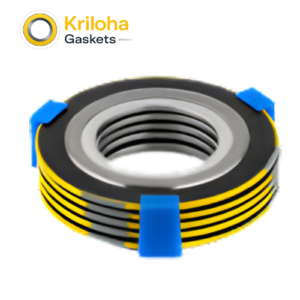
The engineering of a Double Jacket Gasket is a study in material synergy. We begin with a high-performance filler, such as Flexible Graphite or non-asbestos fiber. This filler provides the “spring” and conformability needed to fill flange imperfections. This core is then completely encased in a metallic jacket—usually 0.4mm to 0.5mm thick. The jacket is formed with a “double lap” on the internal diameter, which creates a reinforced metal-on-metal seal at the most critical point of the joint. This construction ensures that even if the internal filler reaches its thermal limit, the metallic shell remains intact to maintain the joint’s structural integrity.

A hallmark of the Kriloha Double Jacket series is our precision Pass-Partition Welding. For heat exchangers with multiple passes, we can integrate partition bars into the main gasket ring. At Kriloha, we use advanced welding and forming techniques to ensure the transitions between the ring and the bars are seamless and leak-proof. We offer jackets in a wide range of materials, including 304/316L Stainless Steel, Soft Iron, Copper, and Inconel, ensuring that the gasket’s metallurgy perfectly matches your flange and process media.

By choosing Kriloha Ltd., you are investing in a product designed for “High-Cycle Reliability.” Our Double Jacket Gaskets are often supplied with a Graphite Coating on the metallic faces to improve initial “wet-out” and sealability on older, pitted flanges. Whether you are managing a massive refinery turnaround or maintaining a critical power plant boiler, Kriloha Double Jacket Gaskets provide the mechanical stamina and thermal endurance required for absolute confidence in your most demanding joints.
Primary Use Cases

  • Shell and Tube Heat Exchangers: The primary sealing solution for heat exchanger headers, especially those requiring pass-partition bars.
  • Boilers and Pressure Vessels: Providing a rugged seal for manway covers and handhole assemblies in high-heat steam systems.
  • Exhaust Manifolds: Managing the intense heat and vibration of large-scale industrial and marine engine exhausts.
  • Gas Turbines: Providing a robust thermal barrier for high-temperature intake and exhaust ports.
  • Refinery Catalytic Crackers: Reliable sealing for high-temperature, high-pressure chemical reactors.

FAQs

What is the difference between a Single Jacket and a Double Jacket gasket?

A Single Jacket covers only the top and edges of the filler, whereas a Double Jacket completely encapsulates the filler on both the top and bottom. This makes the Double Jacket much more resistant to blow-outs and chemical attack.

Can Double Jacket gaskets be used on warped flanges?

While they are somewhat conformable, they require relatively flat flange surfaces compared to pure graphite gaskets. If your flanges are significantly warped, Kriloha recommends using a version with a graphite-faced jacket.

Why are they preferred for heat exchangers?

Heat exchangers often have complex internal “pass bars” to direct fluid flow. Double Jacket construction is the easiest and most reliable way to manufacture a one-piece gasket that includes these complex bar configurations.

Is there a temperature limit for these gaskets?

The limit depends on the metal. For example, a 316L jacket with a ceramic filler can withstand up to 1000°C, while a jacket with a graphite filler is typically limited to 450°C in oxidizing atmospheres.

Do these gaskets require high bolt torque?

Yes. Because you are essentially compressing a metal shell, Double Jacket gaskets require higher seating stresses than standard soft gaskets. Kriloha provides detailed torque charts to ensure a successful seal.

This is the heading

Lorem ipsum dolor sit amet consectetur adipiscing elit dolor

Request a Quote

Enter your details here

Great! We’ve received your information.

We couldn’t process your submission. Please retry

Scroll to Top

Get a Quote

Great! We’ve received your information.

We couldn’t process your submission. Please retry