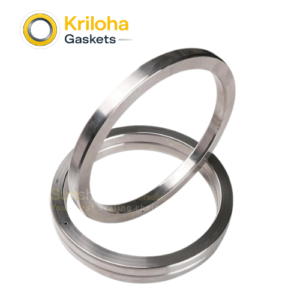
Spiral Wound Inner and Outer Rings

Spiral Wound Inner and Outer Rings

Core Features

  • Precision Centering: Outer rings are engineered to the exact bolt-circle dimensions of ASME B16.20 and EN1514-2 to ensure perfect concentric placement.
  • Anti-Buckling Shield: Inner rings provide essential radial support, preventing the sealing element from “buckling” inward under high bolt loads or internal pressure.
  • Compression Limiter: Both rings act as a definitive mechanical “stop,” protecting the V-shaped windings from being over-compressed and losing their spring-back capability.
  • Heat & Corrosion Barrier: Inner rings shield the winding and filler from direct contact with high-velocity, turbulent, or corrosive process media.
  • Metallurgical Matching: Available in a full spectrum of materials from Carbon Steel (epoxy coated) to 316L, 347, Monel, and Titanium.
  • Fluid Turbulence Reduction: The inner ring fills the void between the flange bore and the gasket ID, smoothing the flow path and reducing erosion.

At Kriloha Ltd., we view the Inner and Outer Rings not merely as accessories, but as the structural skeleton of a high-performance seal. While the spiral winding does the sealing, the rings provide the environment that allows that seal to succeed. As the industry’s top supplier of rubber seals and gaskets, Kriloha Gaskets manufactures these rings with the same CNC precision used in our primary sealing elements, ensuring a “System-Level” approach to flange integrity.

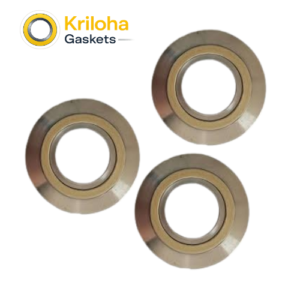
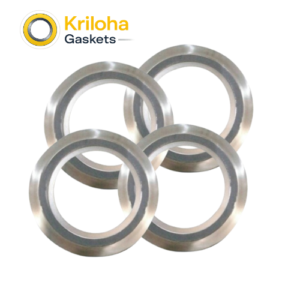
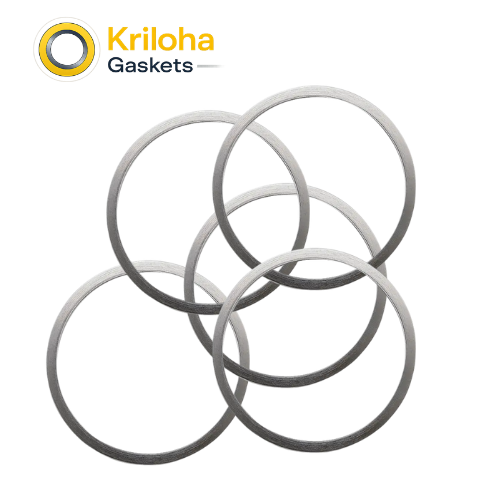
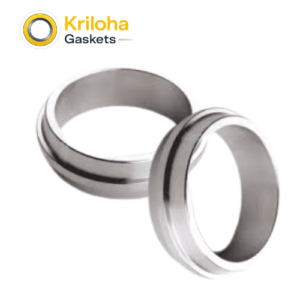
The Outer Ring (also known as a Centering Ring) is the first line of defense during installation. Its primary role is to center the gasket perfectly on the flange face by resting against the bolts. However, its most critical engineering function is acting as a compression stop. Without a Kriloha outer ring, an over-zealous technician could over-torque the bolts, crushing the V-shaped windings until they lose their elasticity. Our rings are calibrated to a specific thickness (standard 3.2mm) that allows the winding to compress to its optimal sealing density without reaching its elastic limit.

The Inner Ring is equally vital, particularly in high-pressure or high-temperature applications. It serves as an internal “shroud” that protects the delicate graphite or PTFE filler from the erosive forces of high-velocity steam or chemicals. More importantly, it prevents a phenomenon known as “inward buckling.” Under intense bolt load, the radial forces can push the spiral windings toward the center of the pipe. If this happens, pieces of the gasket can break off and damage downstream equipment like turbines or pumps. A Kriloha inner ring provides the necessary radial strength to keep the seal in its place.

Furthermore, Kriloha utilizes specialized Anti-Corrosive Coatings for our carbon steel outer rings. While the winding might be stainless steel, the outer ring is often carbon steel to save costs. We apply a high-visibility epoxy or zinc coating to prevent atmospheric rust from migrating toward the sealing face. For high-temperature services, we offer 316L or 347 stainless steel rings to ensure thermal expansion rates match the winding. When you specify Kriloha rings, you are choosing a balanced engineering solution that guarantees your gaskets will perform as designed, from the first bolt-up to the final decommissioning.
Primary Use Cases

  • High-Pressure Piping (Class 900-2500): Mandatory structural support for extreme pressure environments.
  • Vacuum Service: Preventing the atmospheric pressure from pulling the gasket windings into the pipe.
  • PTFE-Filled Gaskets: Essential to counteract the “cold flow” properties of PTFE which can lead to winding displacement.
  • Critical Hydrocarbon Lines: Providing an extra layer of blowout protection in flammable media service.
  • Large Diameter Flanges: Ensuring the sealing element stays flat and circular during the bolting sequence.

FAQs

Why are inner rings now recommended for all graphite-filled gaskets?

Recent updates to ASME B16.20 standards recommend inner rings for all graphite-filled gaskets to prevent buckling, which was found to be a common cause of failure in high-pressure cycles.

Does the outer ring actually do any of the sealing?

No. The outer ring is a structural and centering component. The sealing is performed entirely by the spiral-wound element between the rings.

Can I buy just the rings from Kriloha to repair old gaskets?

We do not recommend this. The rings and the winding are precision-fit during the manufacturing process. Attempting to “retrofit” a ring onto a winding can lead to misalignment and catastrophic leaks.

How do I choose the material for my inner ring?

The inner ring should generally match the metallurgy of the winding or the pipe. If you are using 316L windings to resist corrosion, the inner ring should also be 316L to prevent it from corroding away.

Are Kriloha rings color-coded?

Yes. Following international standards, we color-code the rim of the outer ring (e.g., Green for 316L, Yellow for 304) so that operators can verify the material at a glance after the gasket is installed.

This is the heading

Lorem ipsum dolor sit amet consectetur adipiscing elit dolor

Request a Quote

Enter your details here

Great! We’ve received your information.

We couldn’t process your submission. Please retry

Scroll to Top

Get a Quote

Great! We’ve received your information.

We couldn’t process your submission. Please retry